Supervised learning workflow

Model training and selection

Huanfa Chen - huanfa.chen@ucl.ac.uk

13/12/2025

Last week

  • Framework of supervised learning
  • Evaluation metrics for regression and classification

Objectives of this week

  1. Understand different workflow of supervised learning.
  2. Understand train-test split and train-validation-test split.
  3. Understand cross validation and its extensions
  4. Know when to use different model evaluation methods.

Supervised Learning

\[ \begin{aligned} (x_i, y_i) &\sim p(x, y) \text{ i.i.d.} \\ x_i &\in \mathbb{R}^n \\ y_i &\in \begin{cases} \mathbb{R}, & \text{(regression)} \\ \mathcal{Y} \text{ (finite set)}, & \text{(classification)} \end{cases} \\ \text{learn } f(x_i) &\approx y_i \\ \text{such that } f(x) &\approx y \end{aligned} \]

Challenges of training supervised models

  1. To select evaluation metrics (so that the model solves the right problem)
  2. To design workflow (so that the model generalises well and avoids overfitting)
  • A robust workflow leads to an unbiased evaluation of the model’s generalisation performance
  • It will select effective model hyperparameters (to avoid overfitting)

Various workflows

  1. Train-test split
  2. Train-validation-test split
  3. Cross-validation + test set

Train-Test split

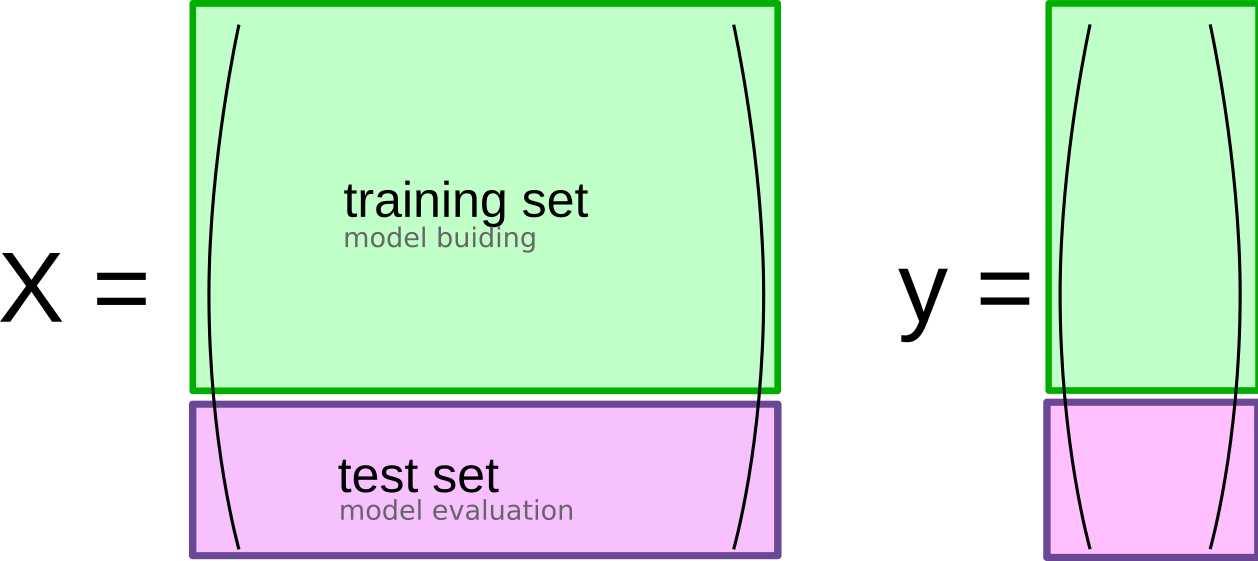
Train-Test Split (usually 75/25)

Train-test split

Why Train-Test Split?

Statistics

  • No train-test split
  • Train and evaluate on whole data
  • Estimation is key
  • Low model complexity

Machine Learning

  • Train-test split
  • Train on part, evaluate on held-out part
  • Prediction (Generalisation) is key
  • High model complexity; overfitting risk

Example - K Nearest Neighbors (KNN)

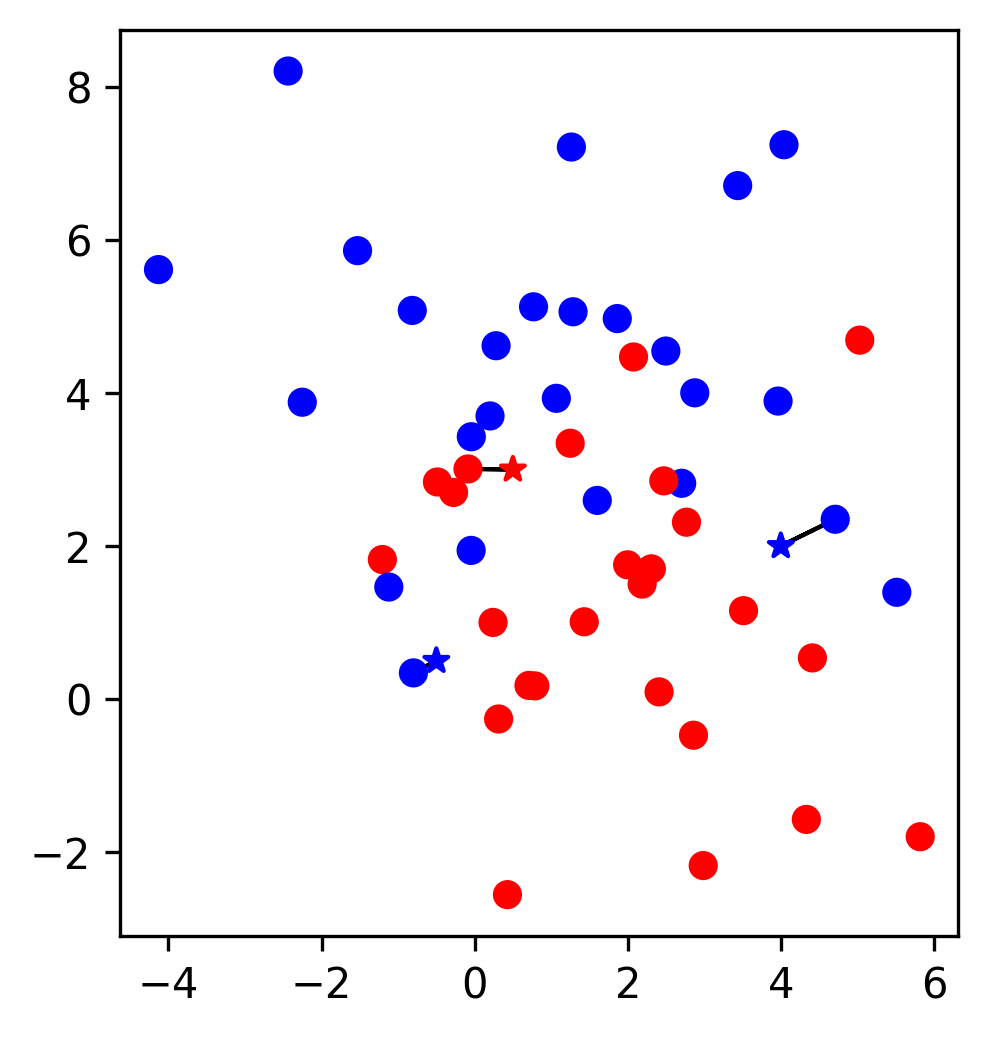
  • With a trained KNN, a new data point is classified by the majority label of its k nearest neighbours in the training set
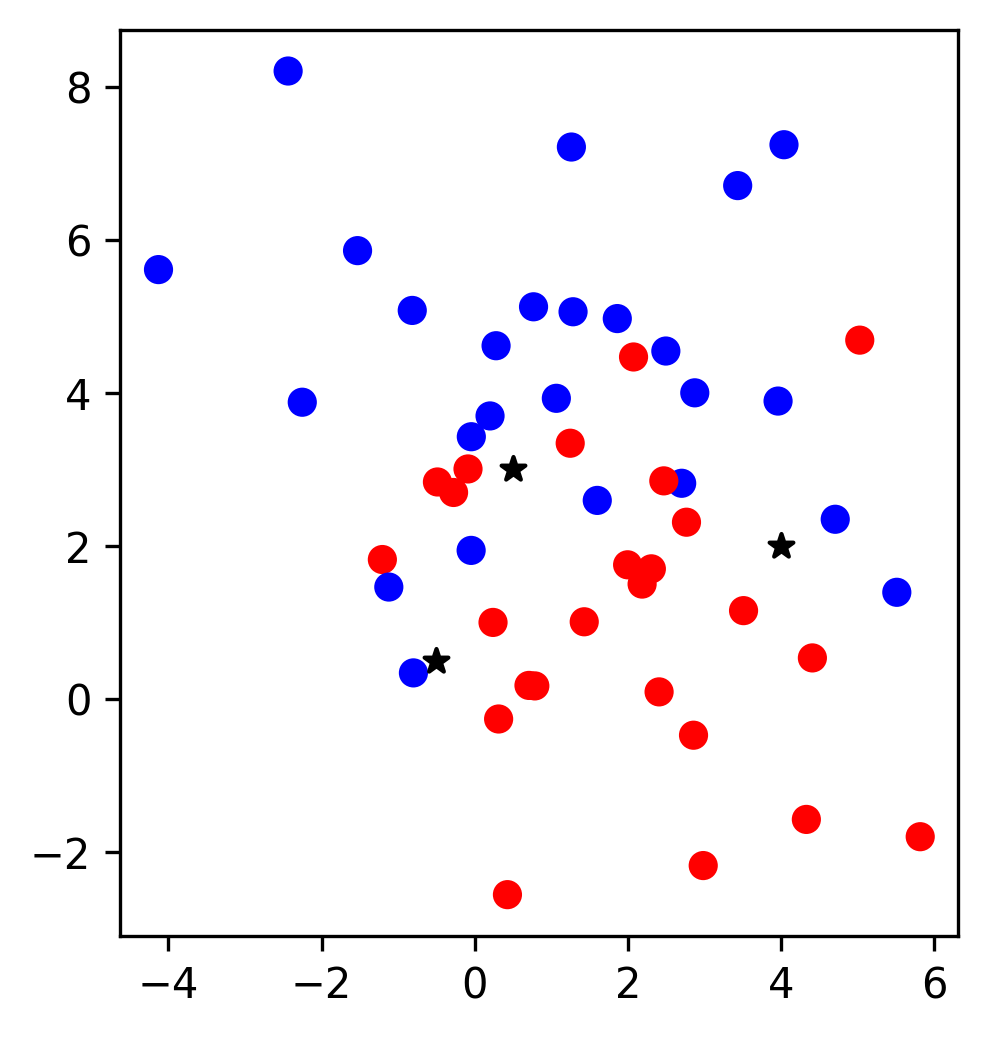
KNN boundary with test points

KNN (k=1)

  • When k=1, a new data point is labelled by its nearest neighbour
  • Sensitive/Complex decision boundary

KNN boundary k=1

KNN (k=3)

  • The label of a new data point is the majority vote of its 3 nearest neighbours
  • The decision boundary is less complex and less sensitive to training data
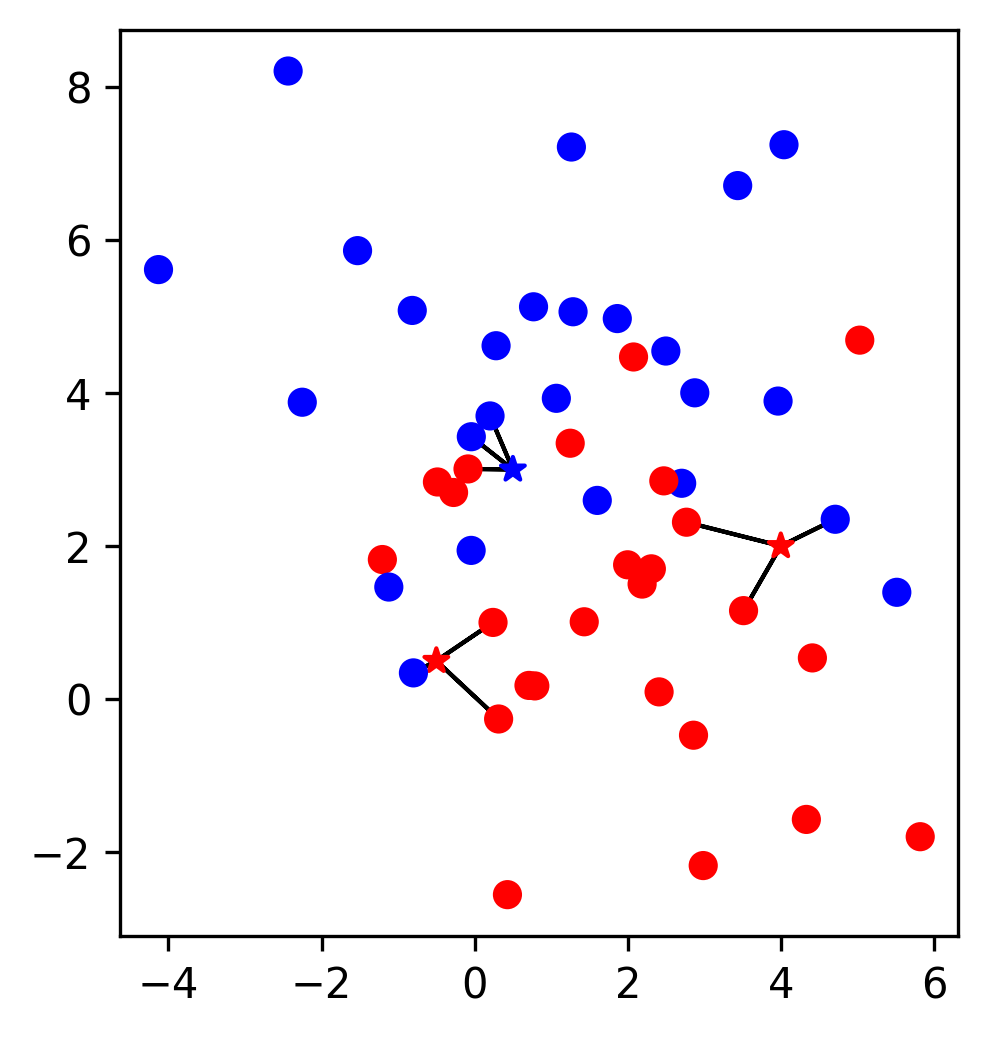
KNN boundary k=3

Influence of n_neighbors

  • Trade-off between complexity and generalisation
  • Smaller k → complex boundary, higher model complexity, lower generalisation
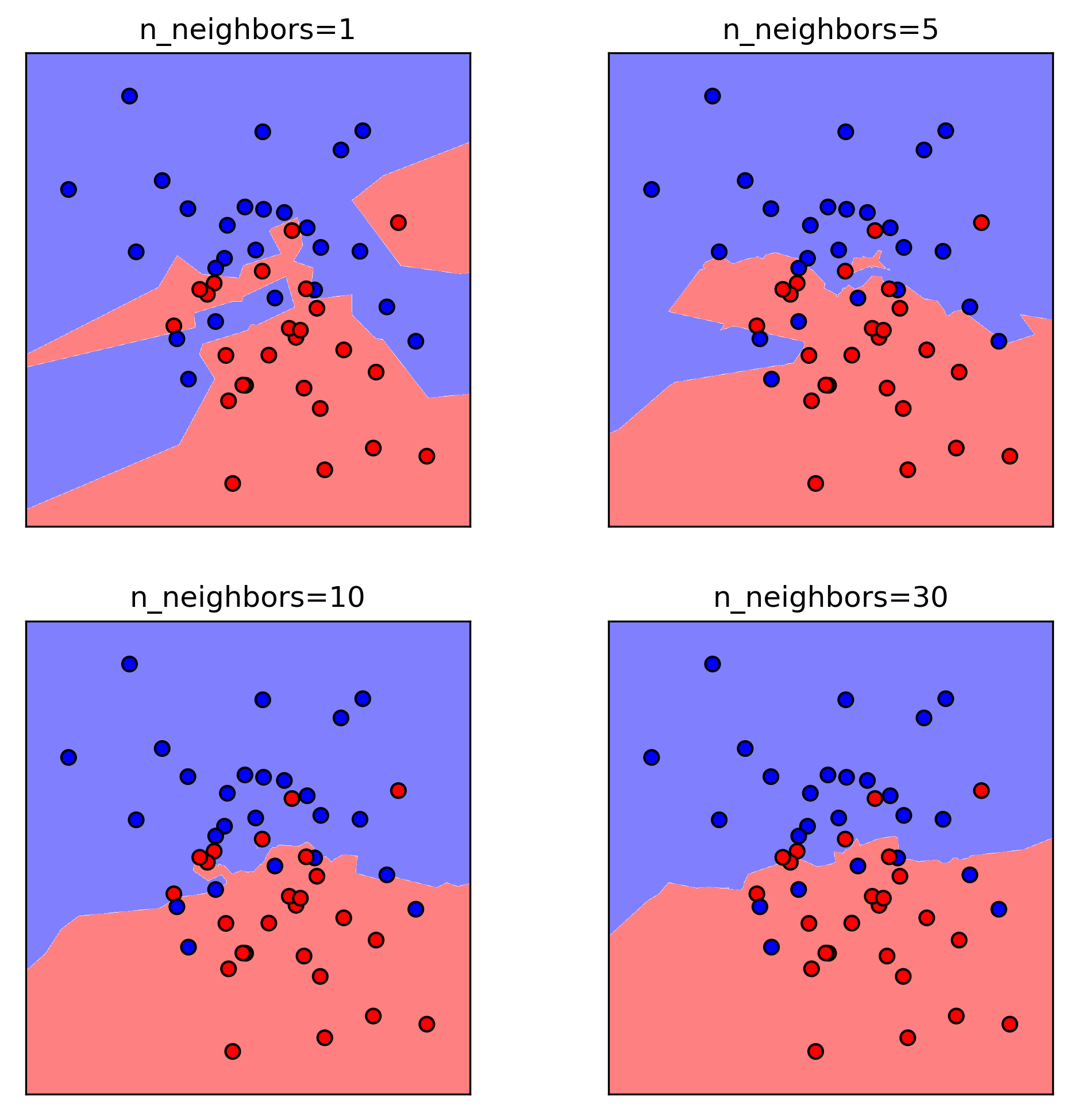
KNN boundary varying k

Model Complexity

KNN model complexity

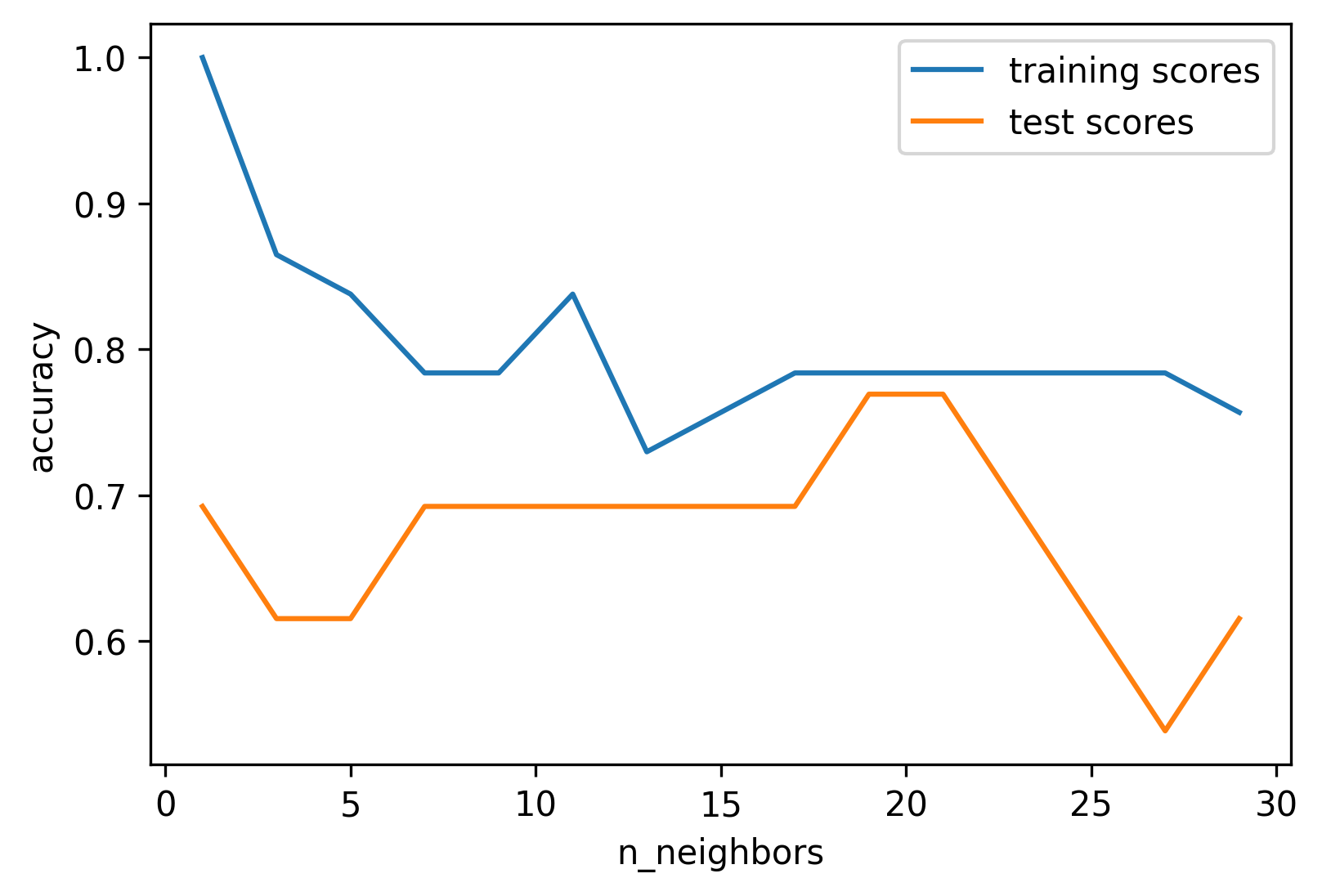
  • Train score ↓ as k increases
  • Test score peaks at intermediate k

Overfitting vs Underfitting

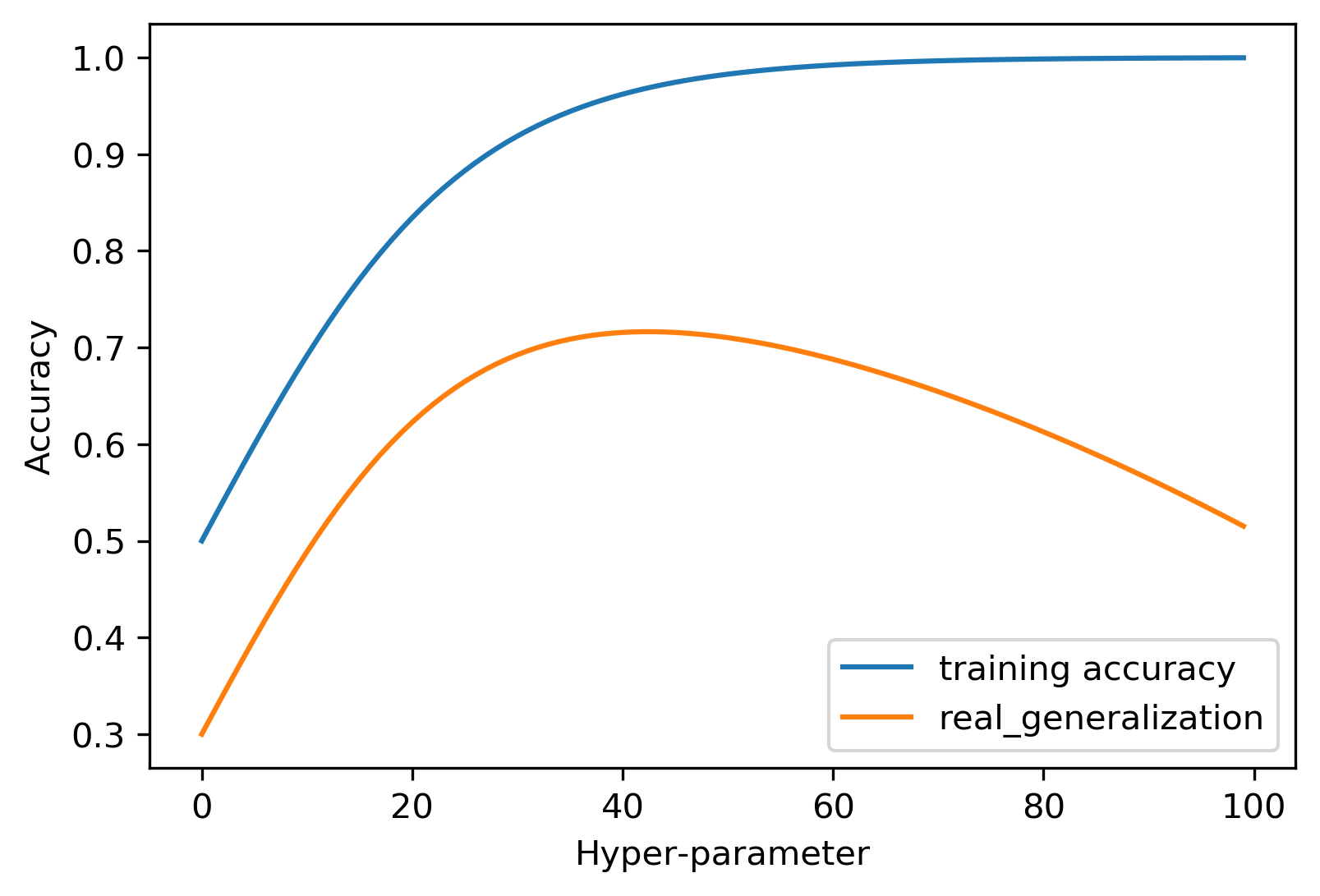
  • Performance on training data generally increases with model complexity
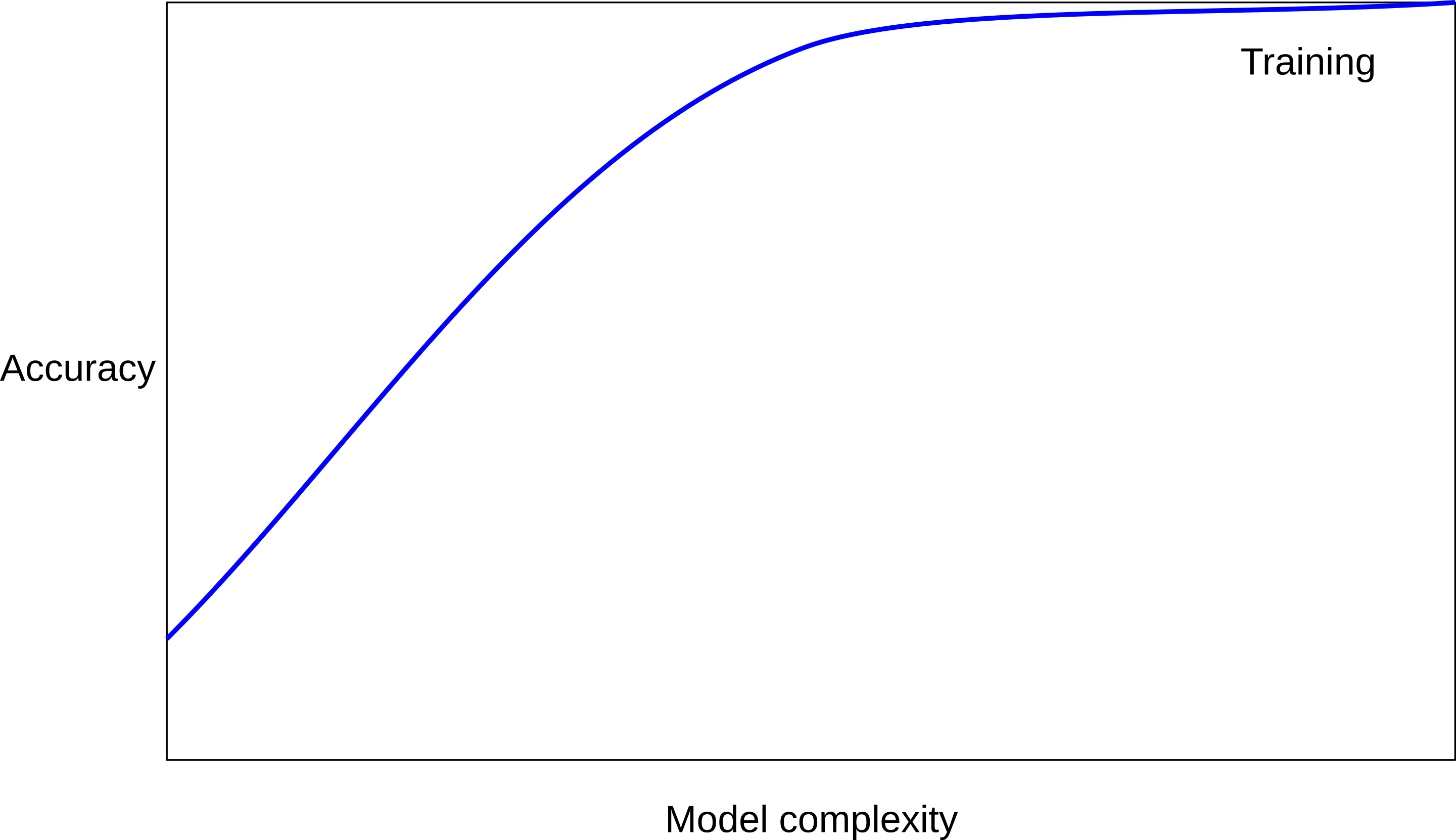
    Overfitting vs Underfitting (train)

Overfitting vs Underfitting

  • Performance on testing data firstly increases with model complexity, and then decreases due to overfitting on training data
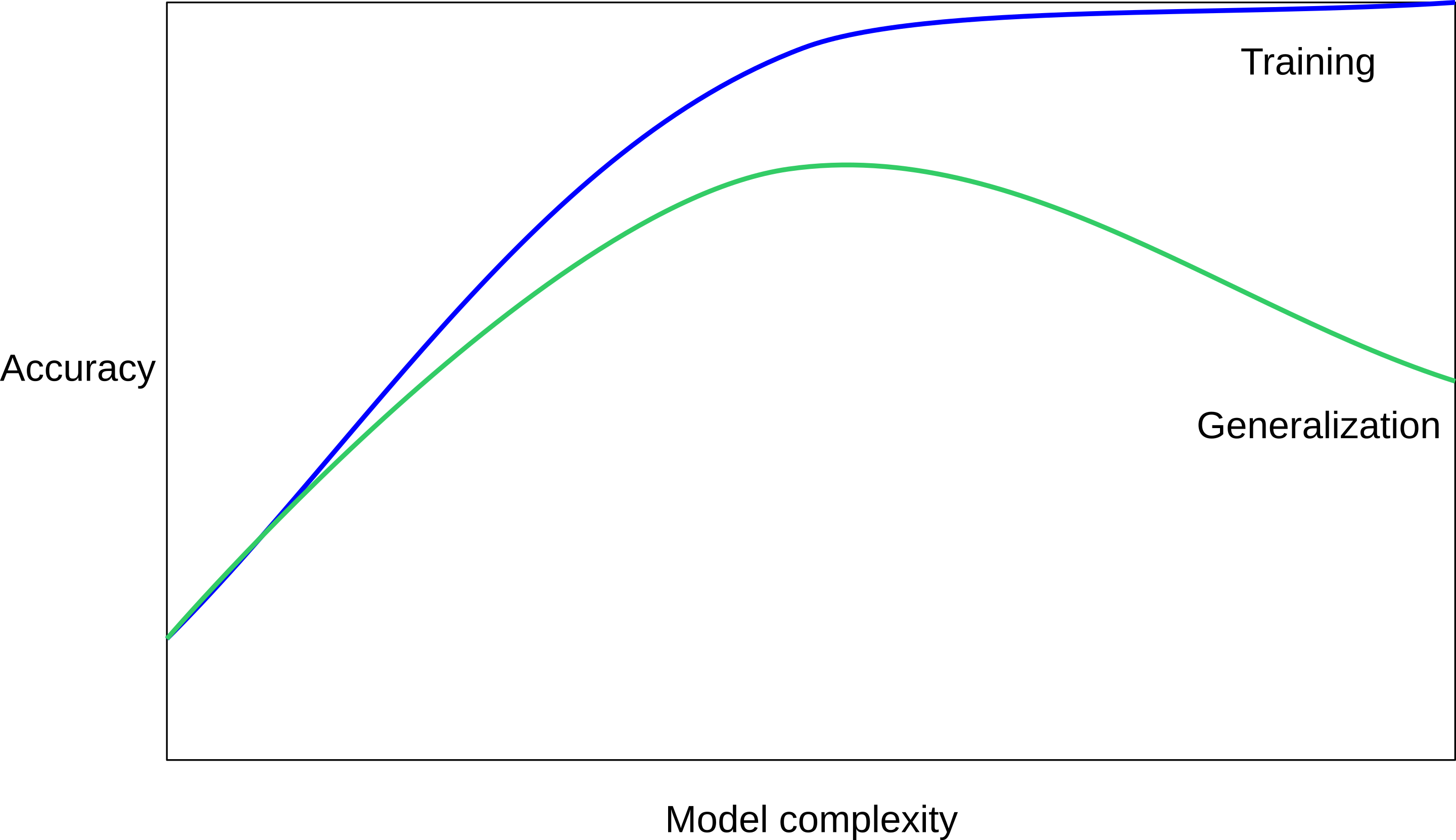
    Overfitting vs Underfitting (generalization)

Overfitting vs Underfitting

  • The optimal hyperparameter achieves balance between underfitting and overfitting
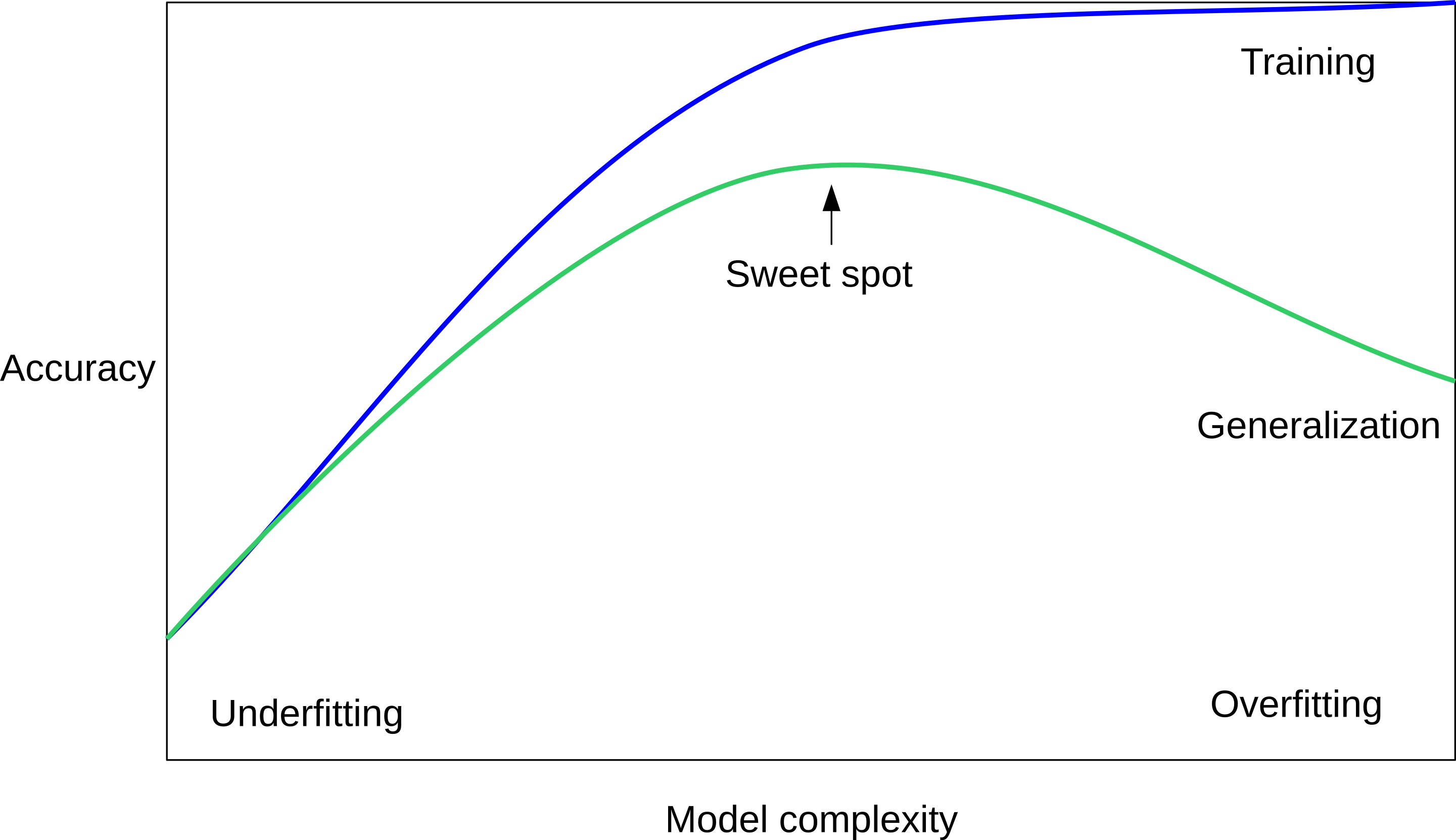
Overfitting vs Underfitting (full)

Using test set to select k and evaluate performance. Happy ending?

  • Report: best k=19, test accuracy=0.77
  • Good for choosing k
  • But the testing accuray is overly optimistic and biased
  • Problem: test set is used twice, for both choosing k and final evaluation

Summary of train-test split

  • The idea is to train the model on the training set, and evaluate it on the test set.
  • But, problematic to use the test set for both hyperparameter tuning and final evaluation.
  • If we need to choose model hyperparameters, we need a separate validation set (or cross-validation).

Train-validation-test split

Idea

  • Training → Validation (hyperparams tuning) → Test (final eval)
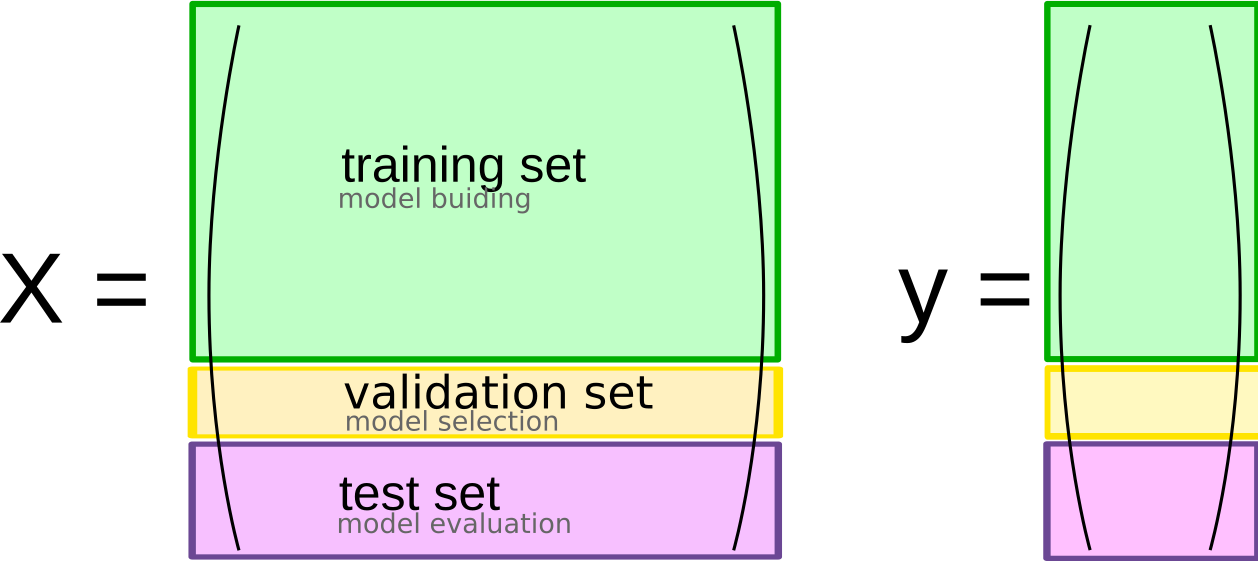
Train/validation/test split

Why using three-hold split?

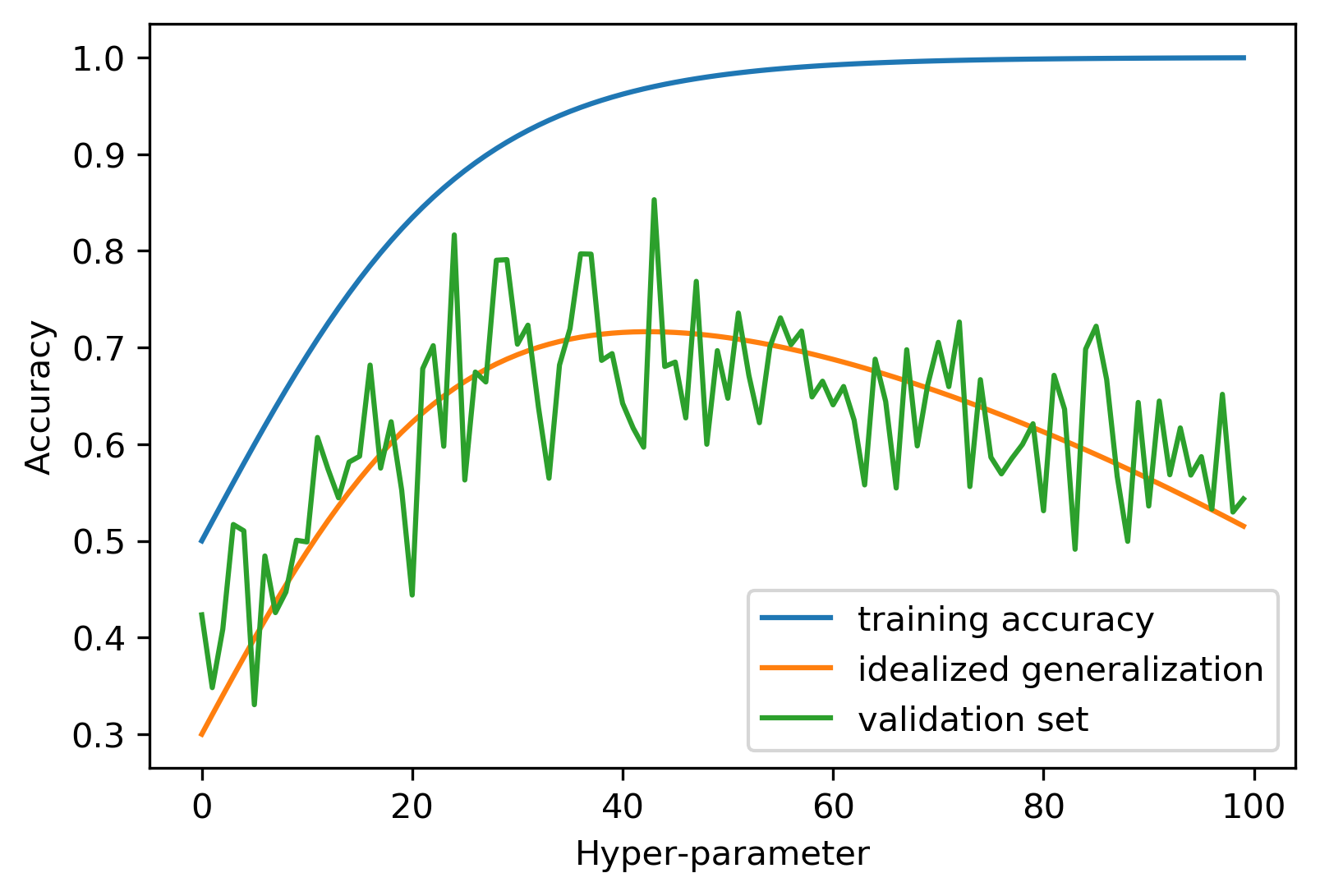
Overfitting validation 1

Overfitting the Validation Set

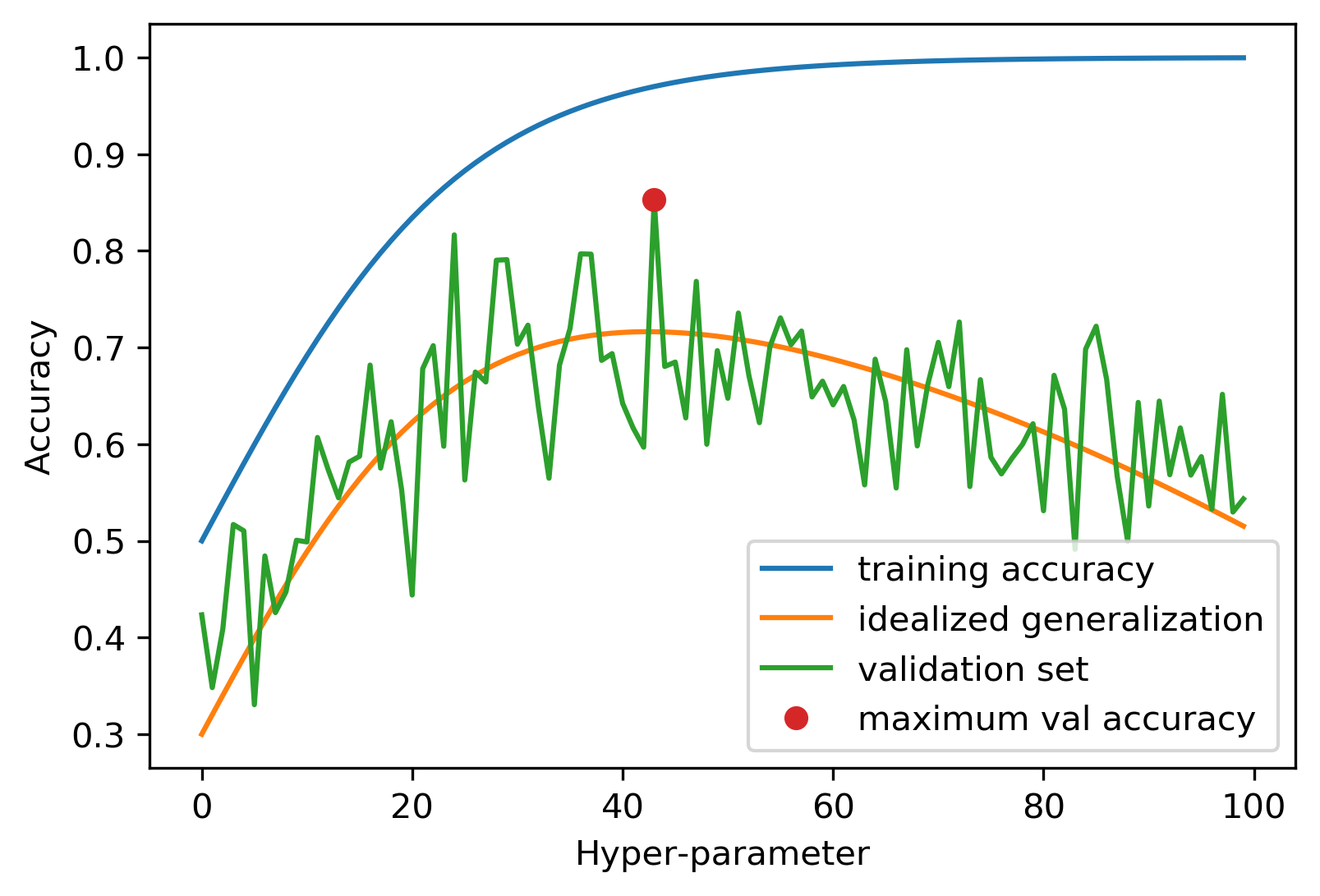
Overfitting validation 2

Overfitting the Validation Set

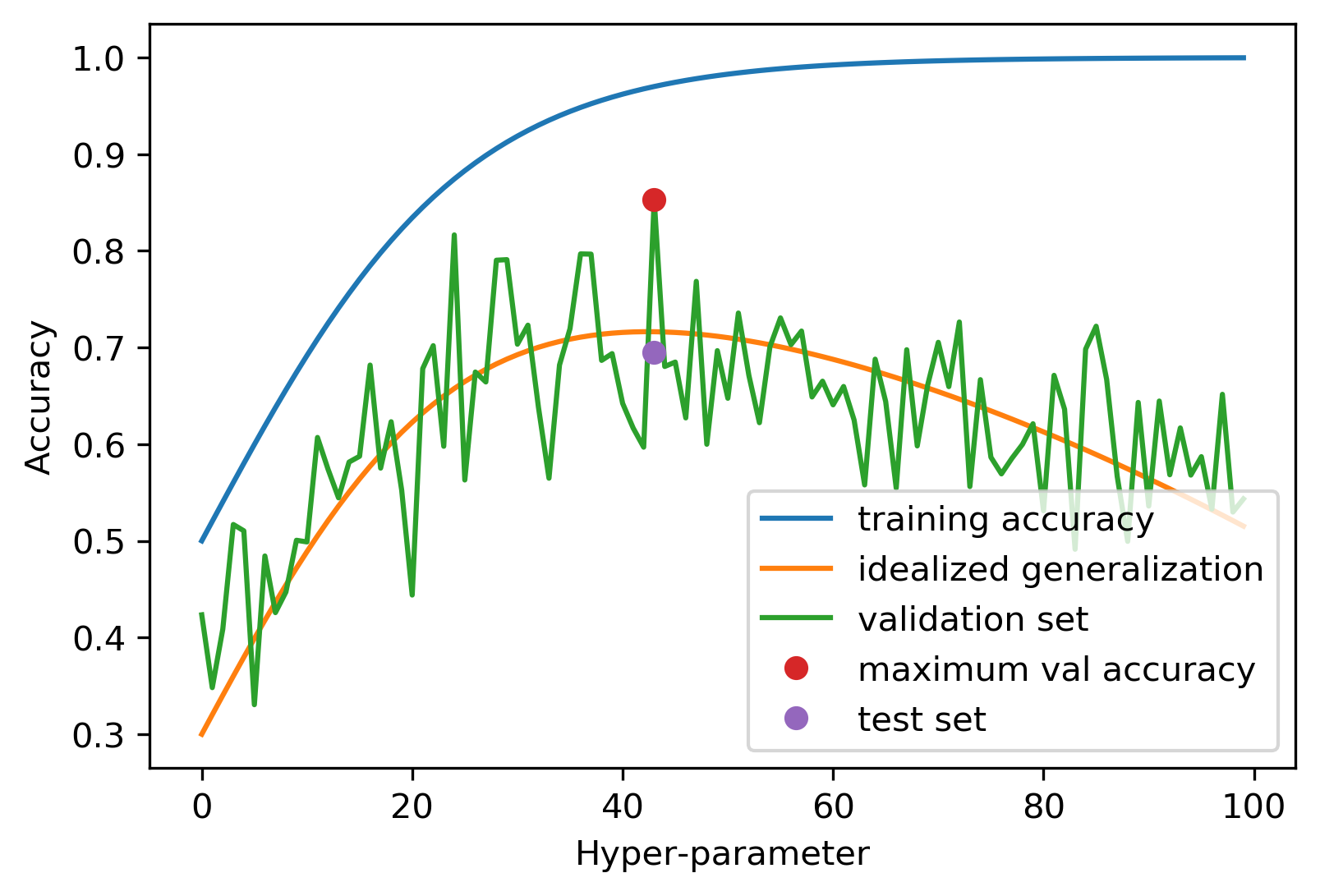
Overfitting validation 3

Overfitting the Validation Set

Overfitting validation 4

Threefold Split (Code)

X_trainval, X_test, y_trainval, y_test = train_test_split(X, y, random_state=0)
X_train, X_val, y_train, y_val = train_test_split(X_trainval, y_trainval, random_state=0)

val_scores = []
neighbors = np.arange(1, 15, 2)
for i in neighbors:
    knn = KNeighborsClassifier(n_neighbors=i)
    knn.fit(X_train, y_train)
    val_scores.append(knn.score(X_val, y_val))
print(f"best validation score: {np.max(val_scores):.3}\n")
best_n_neighbors = neighbors[np.argmax(val_scores)]
print(f"best n_neighbors:{best_n_neighbors}\n")

knn = KNeighborsClassifier(n_neighbors=best_n_neighbors)
knn.fit(X_trainval, y_trainval)
print(f"test-set score: {knn.score(X_test, y_test):.3f}")
  • best validation score: 0.991
  • best n_neighbors: 11
  • test-set score: 0.951

New problem with threefold split

  • Fixed train-val-test split: results depend on split
  • High variance in best k and test score, not robust
   random_seed  best_validation_score  best_k  test_set_score
0            0                    0.7       5        0.846154
1            1                    0.7       1        0.538462
2            2                    1.0      13        0.692308
3            3                    0.7       1        0.846154
4            4                    0.9       5        0.769231
5            5                    0.8      11        0.769231

Cross-Validation + Test Set

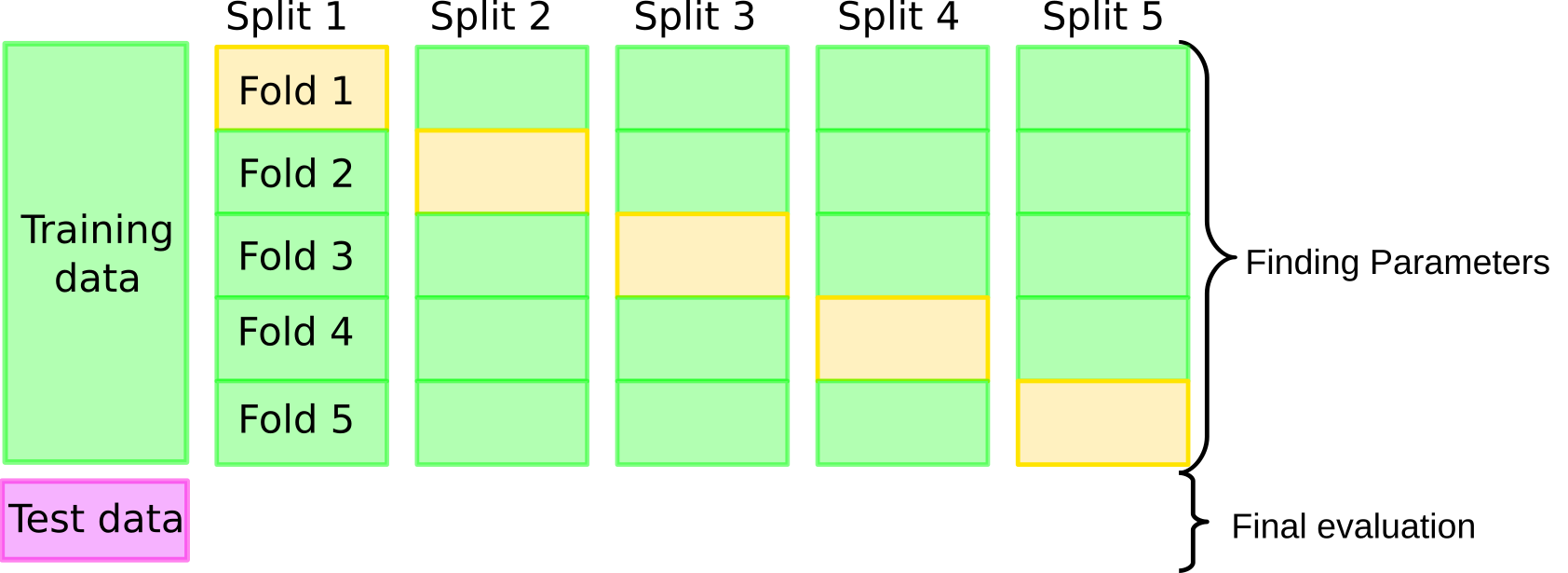
Idea

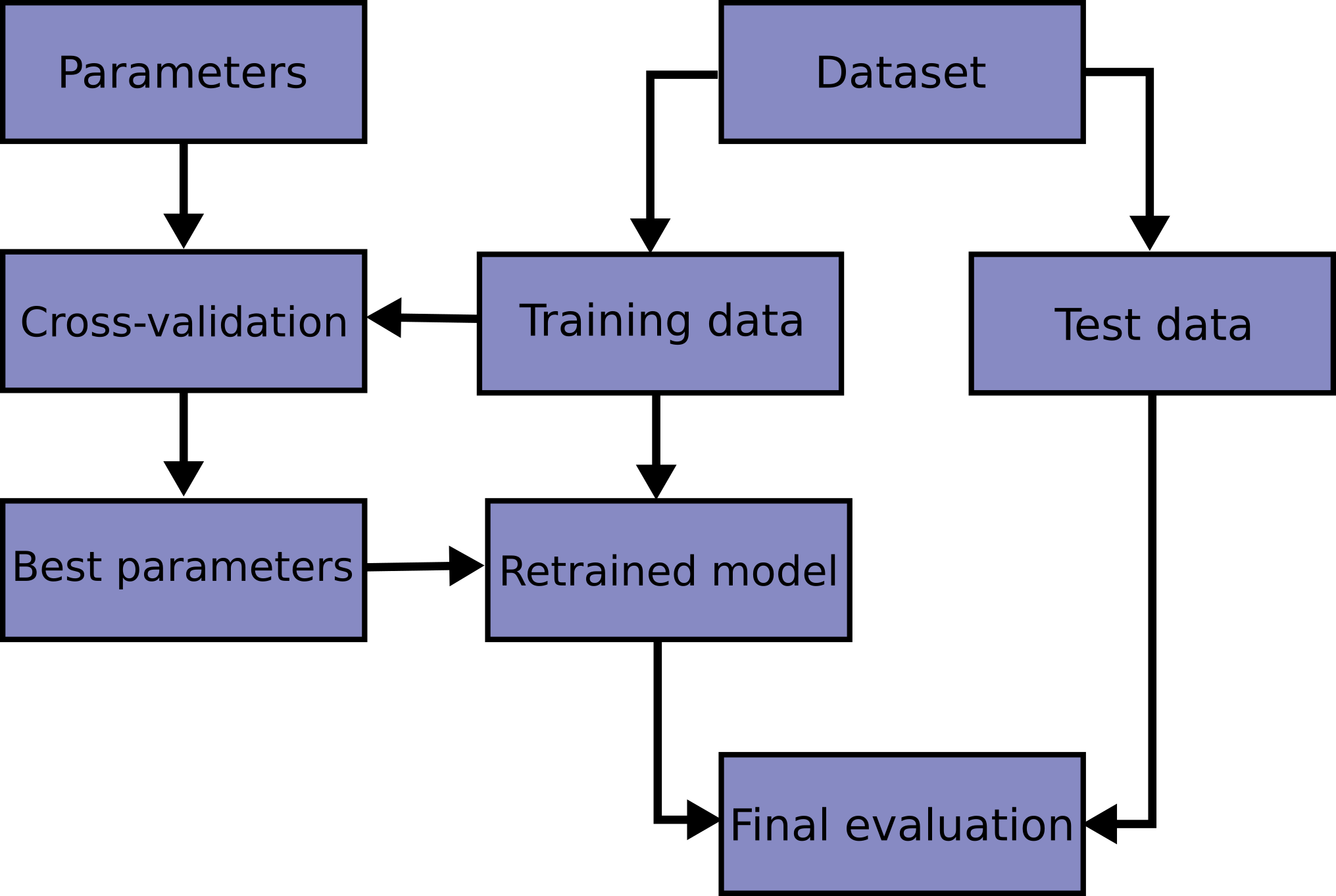
Grid search with CV and test set

Grid-Search with CV (Code)

from sklearn.model_selection import cross_val_score

X_train, X_test, y_train, y_test = train_test_split(X, y)

cross_val_scores = []
for i in neighbors:
    knn = KNeighborsClassifier(n_neighbors=i)
    scores = cross_val_score(knn, X_train, y_train, cv=10)
    cross_val_scores.append(np.mean(scores))

best_n = neighbors[np.argmax(cross_val_scores)]
knn = KNeighborsClassifier(n_neighbors=best_n)
knn.fit(X_train, y_train)
print(f"test-set score: {knn.score(X_test, y_test):.3f}")
test-set score: 0.615

Grid-Search Workflow

Grid search workflow

GridSearchCV (Code)

from sklearn.model_selection import GridSearchCV

X_train, X_test, y_train, y_test = train_test_split(X, y, stratify=y)
param_grid = {'n_neighbors':  np.arange(1, 30, 2)}

grid = GridSearchCV(KNeighborsClassifier(), param_grid=param_grid, cv=10,
                    return_train_score=True)

grid.fit(X_train, y_train)
print("best parameters:", grid.best_params_)
print(f"test-set score: {grid.score(X_test, y_test):.3f}")
best parameters: {'n_neighbors': np.int64(17)}
test-set score: 0.615

GridSearchCV Results

import pandas as pd
results = pd.DataFrame(grid.cv_results_)
results.params.head()
0    {'n_neighbors': 1}
1    {'n_neighbors': 3}
2    {'n_neighbors': 5}
3    {'n_neighbors': 7}
4    {'n_neighbors': 9}
Name: params, dtype: object

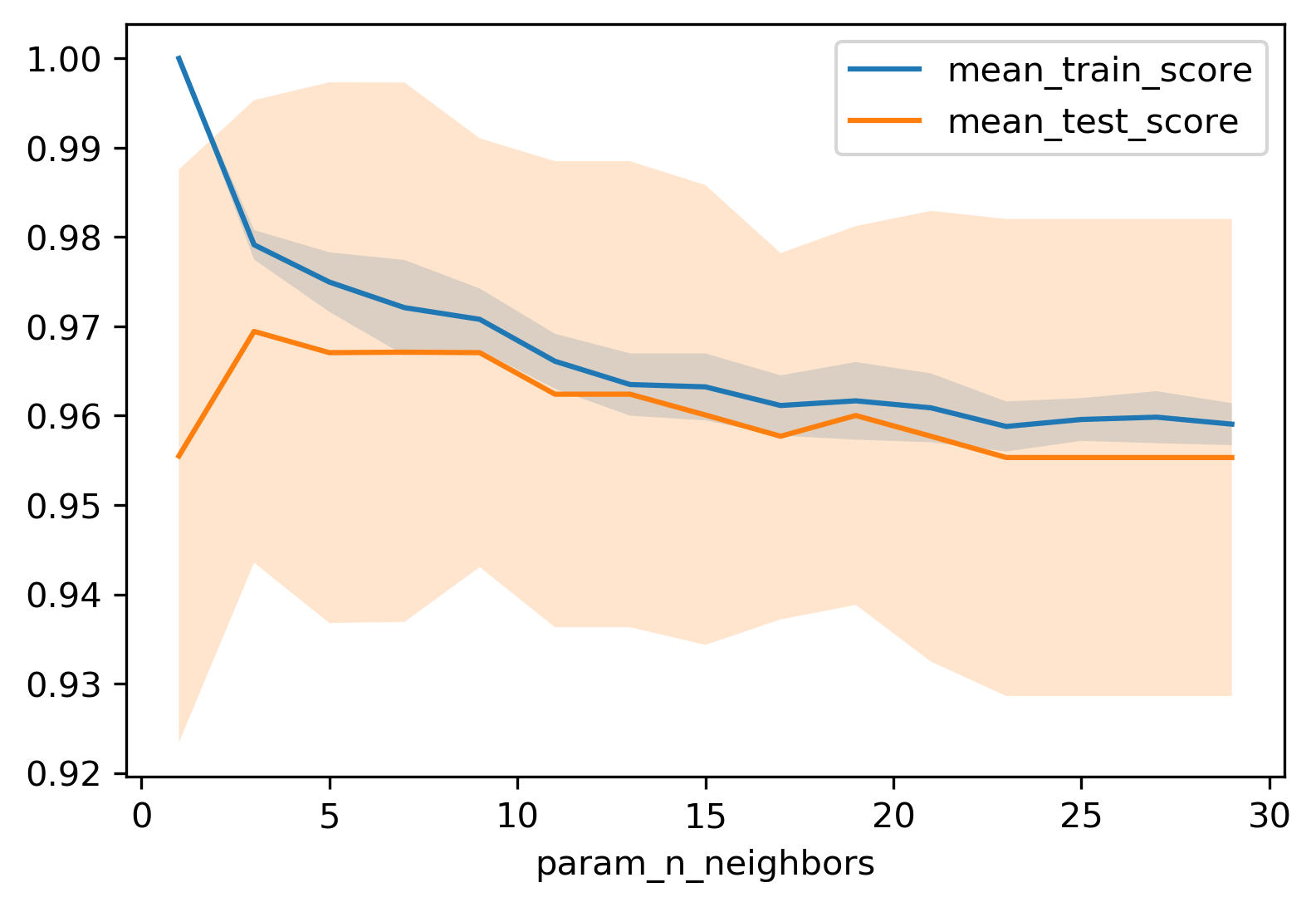
n_neighbors Search Results

Grid search n_neighbors

How many folds in CV?

  • Recommend to run 5-fold (default in sklearn) or 10-fold CV
  • #folds represents a trade-off between computing time and performance estimate quality
  • More folds → more training data per fold → better generlisation performance estimate, but longer computing time
  • Computing time is key for large datasets and complex models.
  • Advice: start with train model without CV, get computing time T, then estimate CV time as approximately T × #folds.

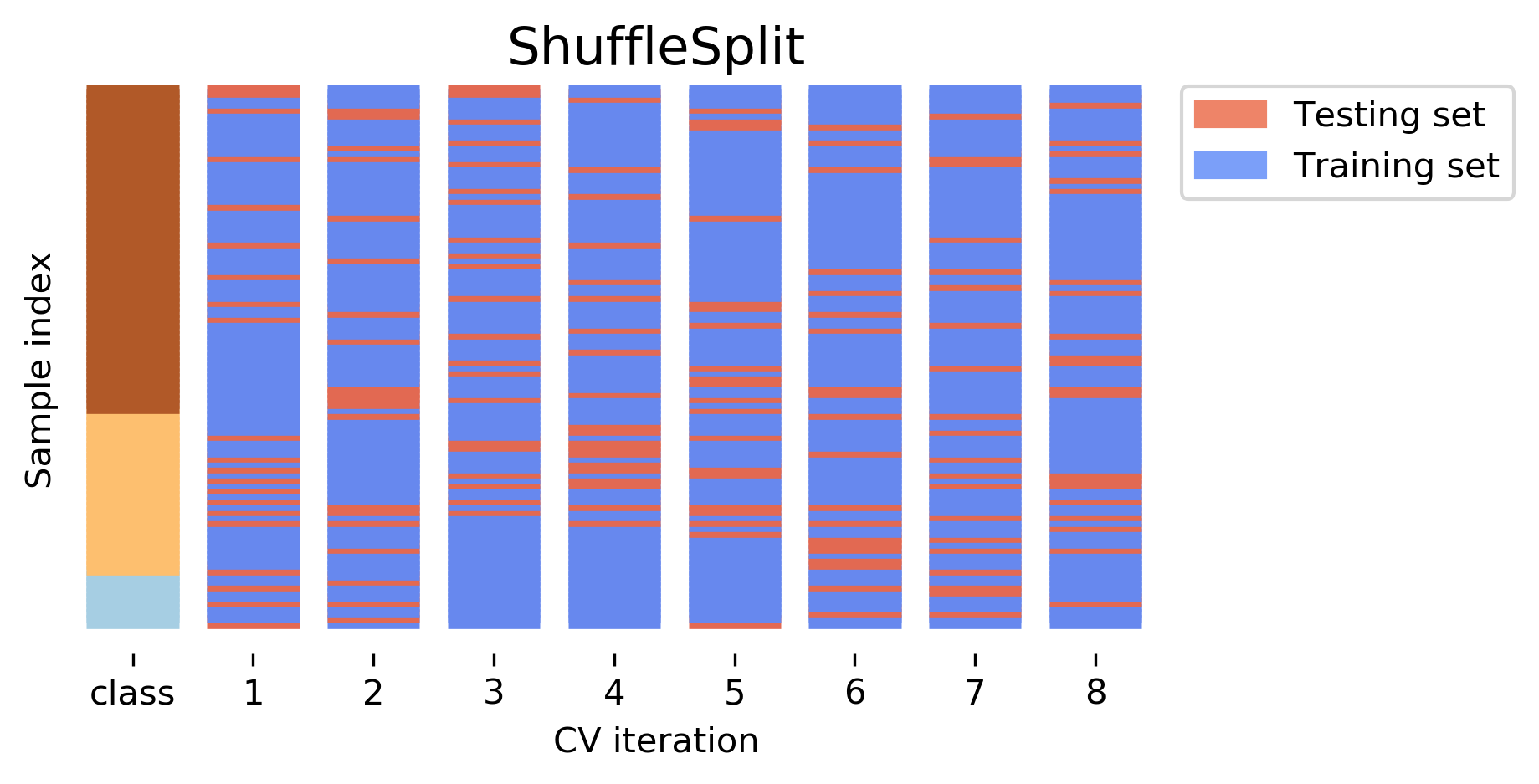
Should data be shuffled in CV?

  • In sklearn, KFold does not shuffle data and is subject to data ordering
  • Recommend to set shuffle=True in KFold, or using ShuffleSplit function

Shuffle split

CV extensions

  • StratifiedKFold: for multiclass classification or imbalanced data
  • GroupKFold: for grouped data
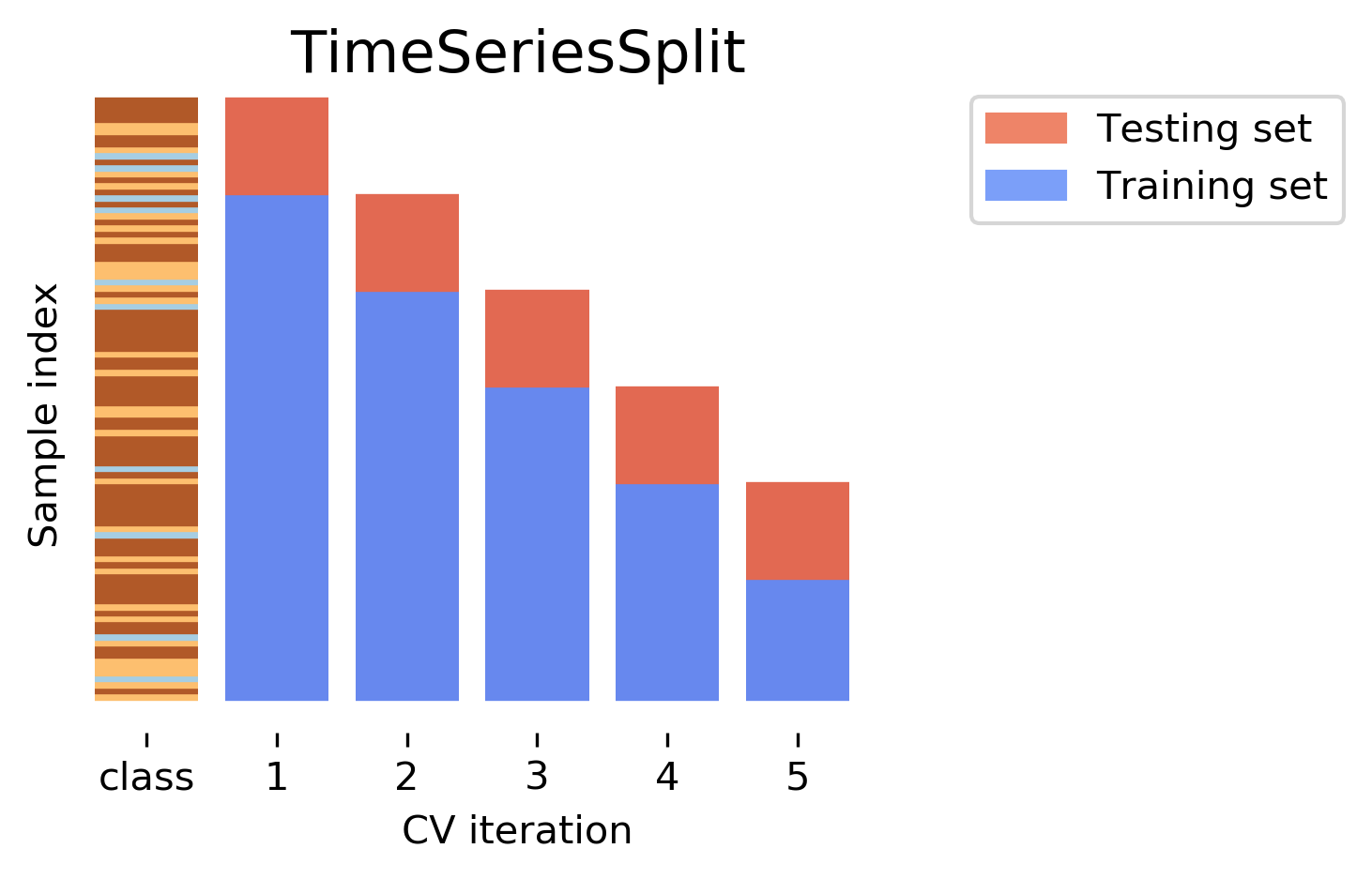
  • TimeSeriesSplit: for time series data

Stratified CV

  • Standard CV leads to folds with different class distributions
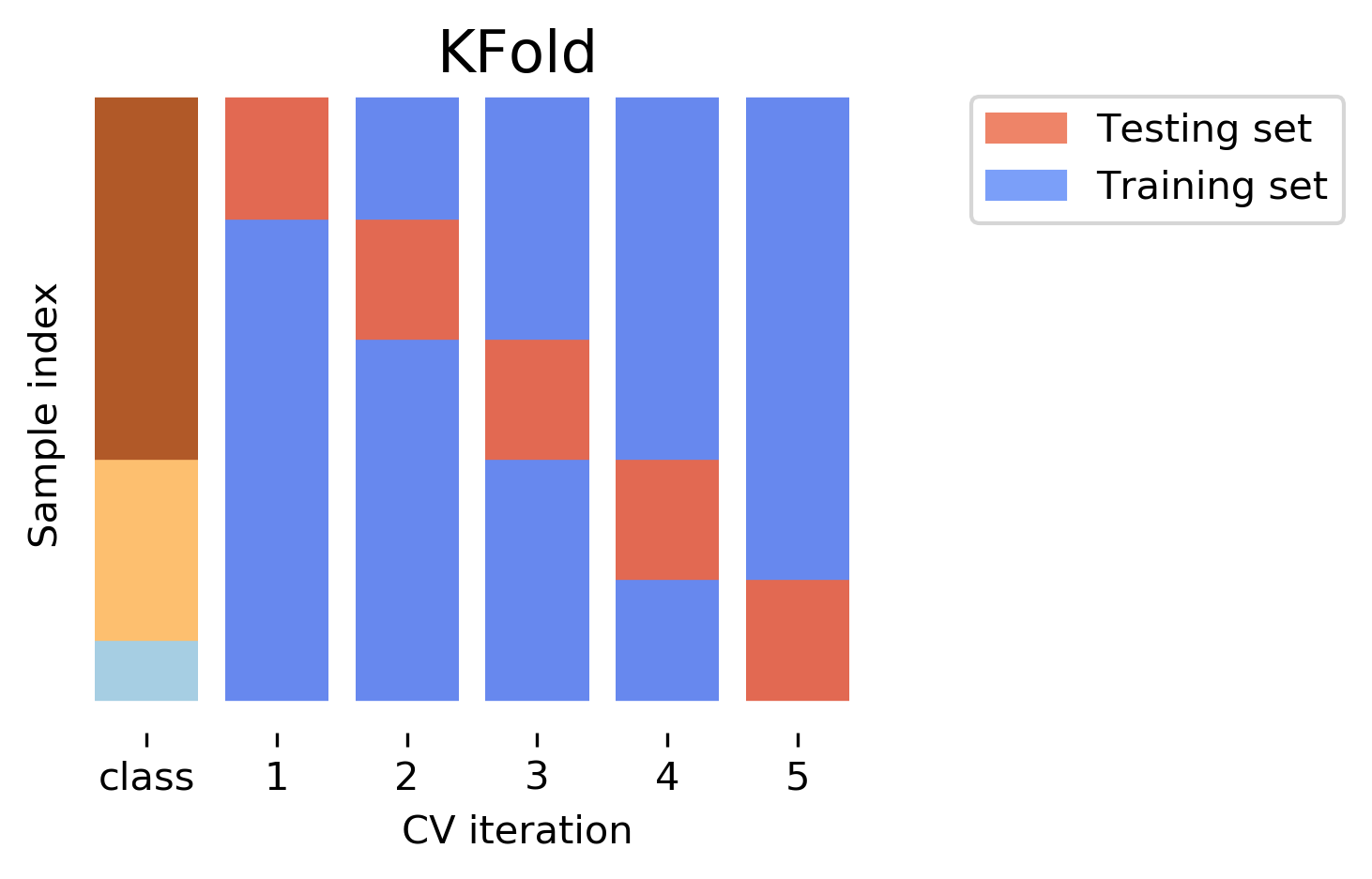
KFold CV

Stratified CV: for multiclass classification or imbalanced data

  • Preserve class distribution in each fold
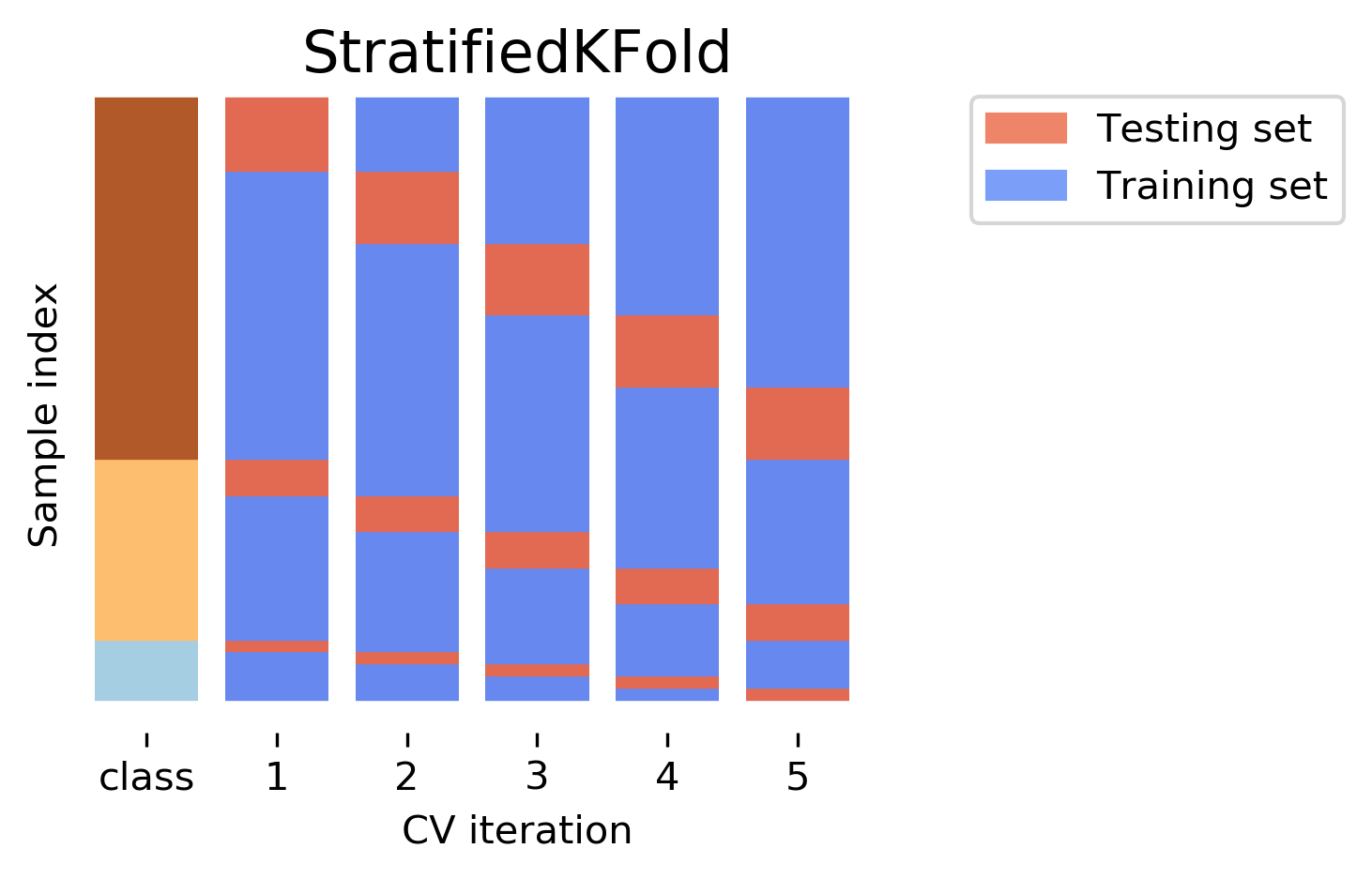
Stratified CV

Stratified CV (Code)

#| echo: true
dc = DummyClassifier('most_frequent')
skf = StratifiedKFold(n_splits=5, shuffle=True)
np.mean(cross_val_score(dc, X, y, cv=skf))

CV for grouped data?

  • CV is more complicated when data are grouped
  • Data points within a group are correlated (e.g., city, patient, user)
  • e.g. The task is to if a patient has a disease based on medical records from 9 cities
  • How CV should be done depends on the application scenario

Scenario 1: To predict new data from any existing cities (same distribution as training data)

  • Standard CV (e.g. KFold, RepeatedKFold) can be used
  • Group information can be ignored

Scenario 2: To predict new data from unknown cities (not i.i.d.)

  • GroupKFold should be used; ensure each group is contained in exactly one fold (either train or test)
  • Data from 9 cities; 5-fold CV; GroupKFold as below.
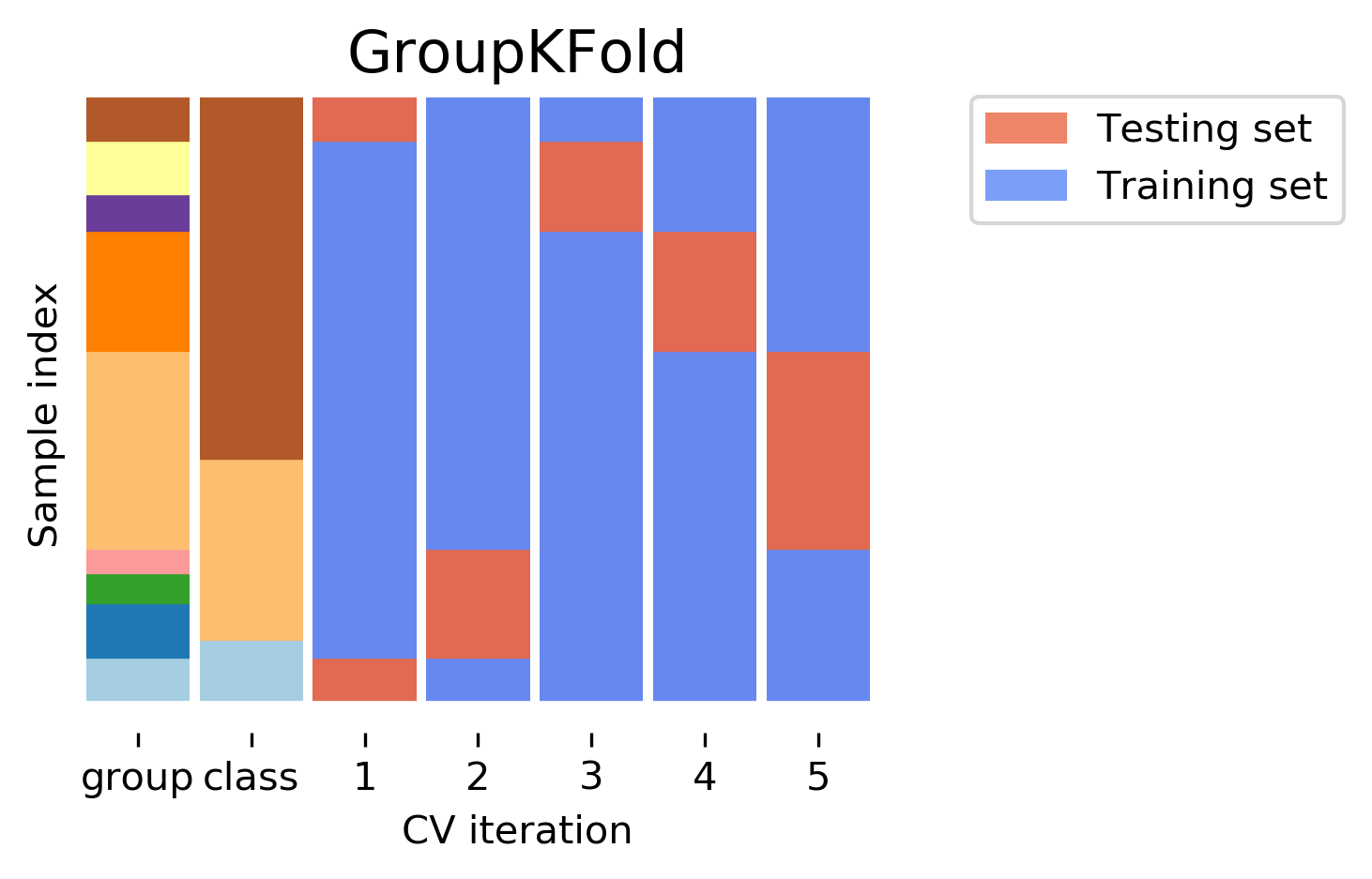
Group KFold

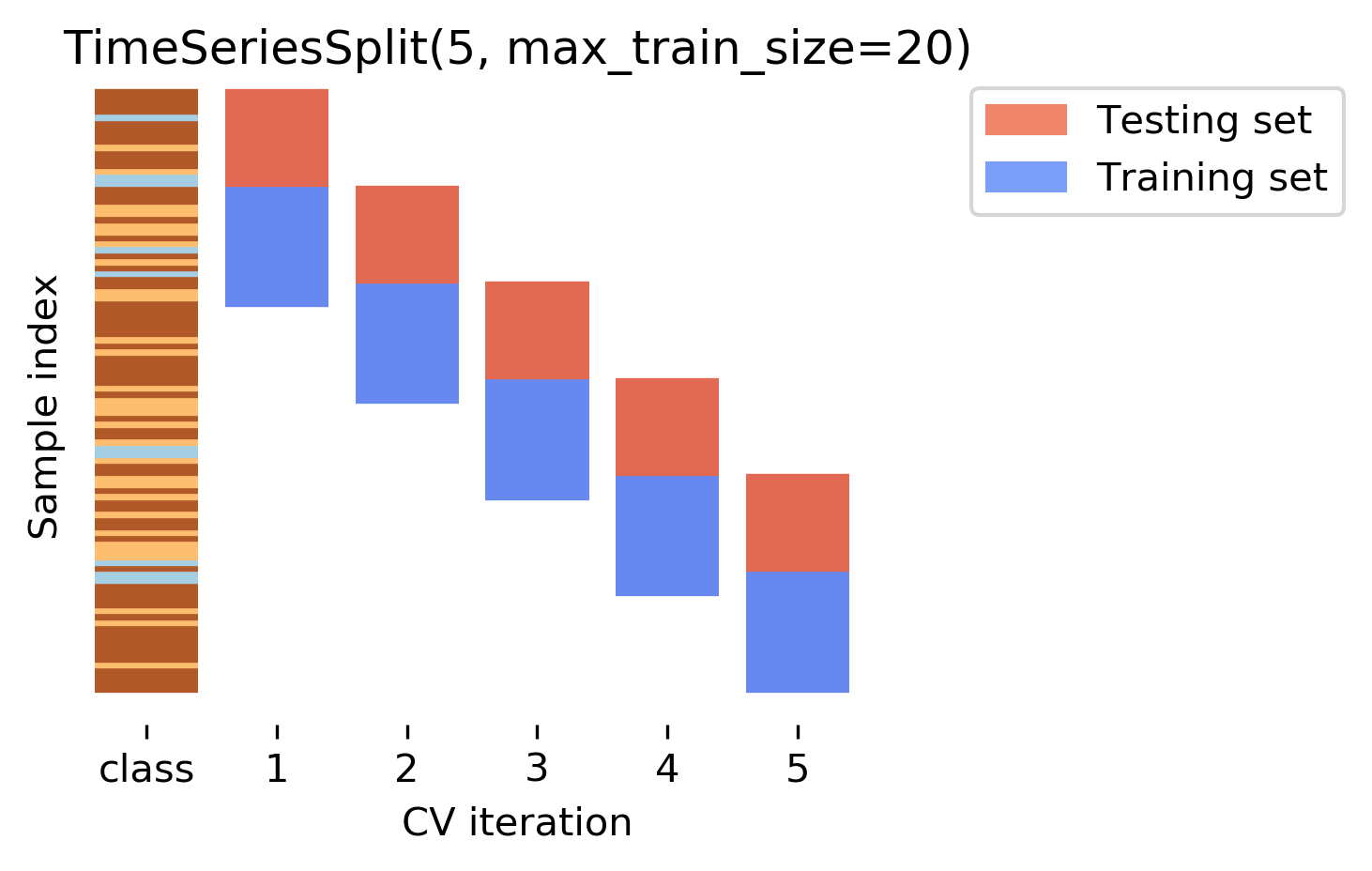
CV for time series?

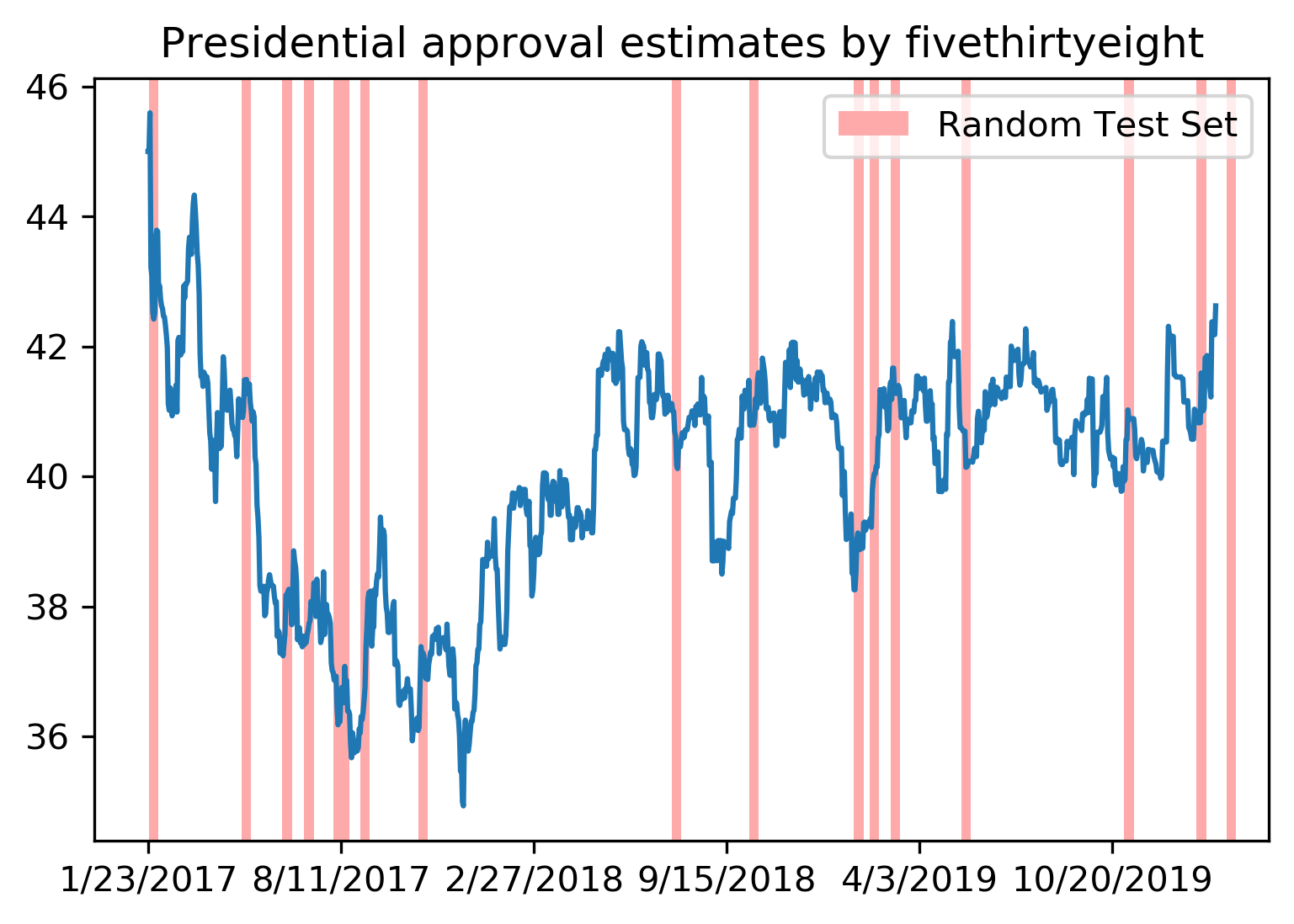
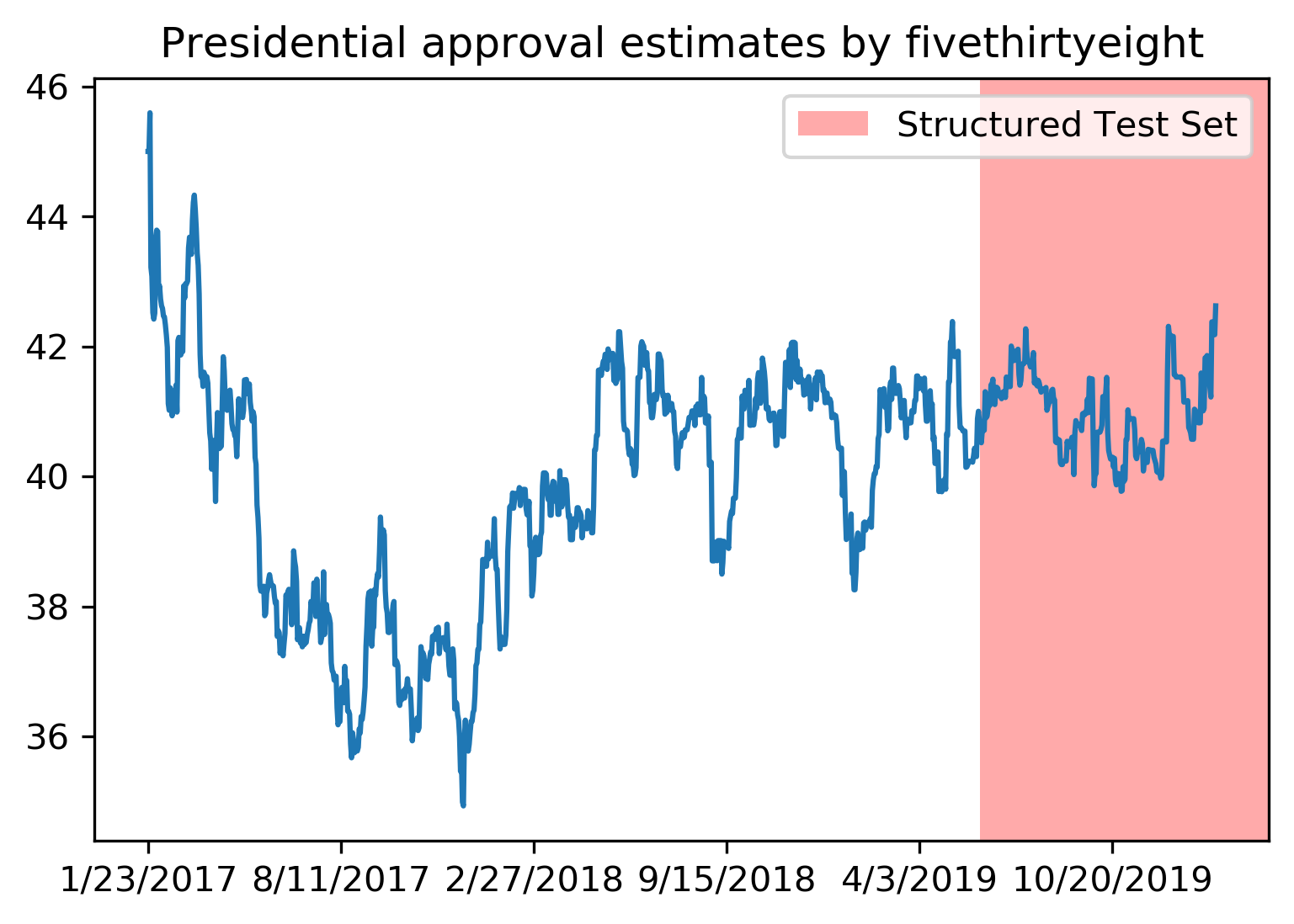
  • Data is collected over time and is not i.i.d.; future data depends on past data
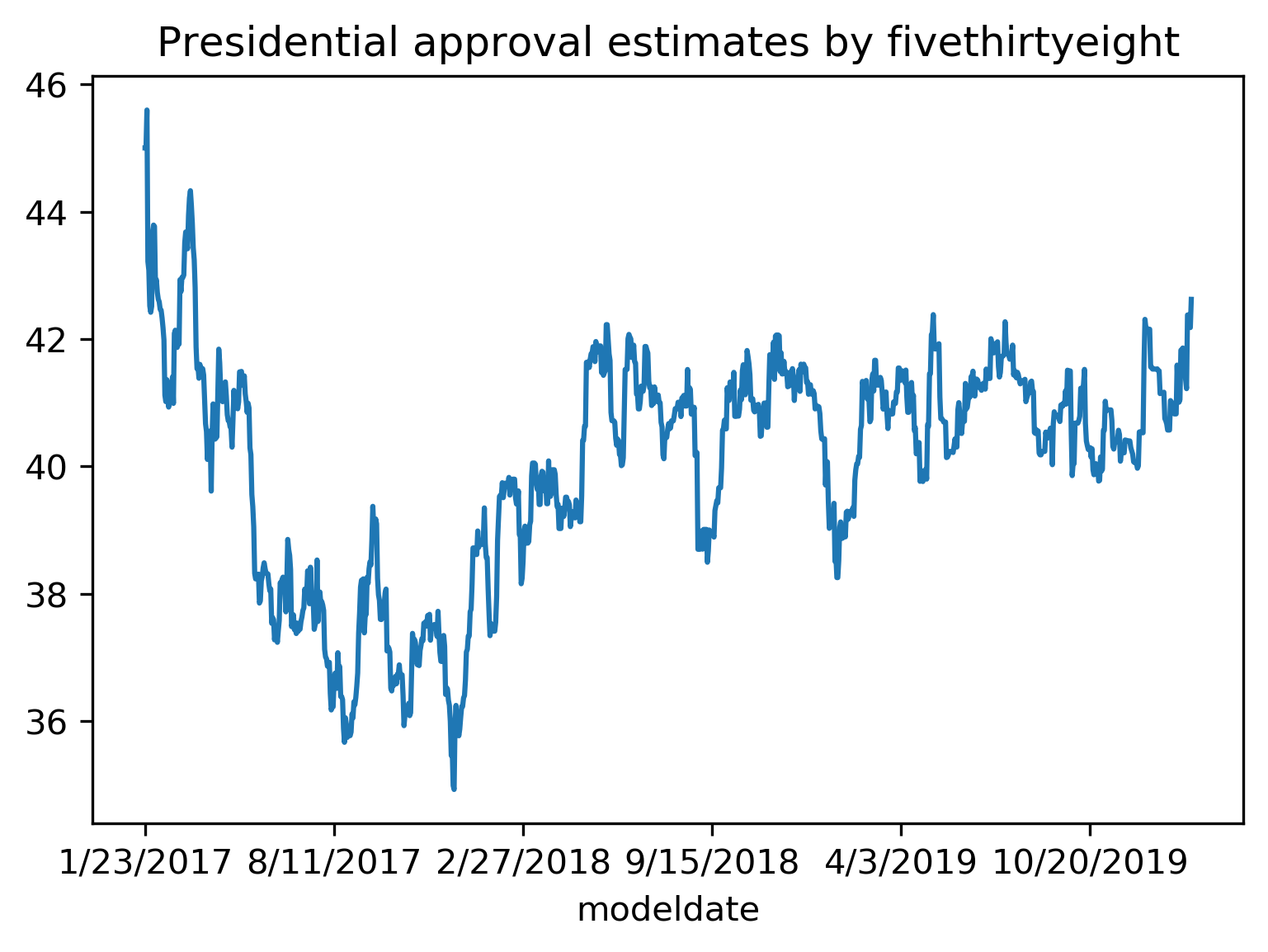
Time series 1

Standard train-test split or CV not suitable for time series
Time series 2

Train-Test Split for Time Series

  • Using past data to train, future data to test
Time series 3

TimeSeriesSplit

Walk-forward CV

Time Series CV

Time series CV

Overview

We’ve covered:

  • Train-test split, threefold split (not recommended)
  • Cross-validation and test set is recommended
  • In cross-validation, recommended to use 5-fold or 10-fold CV with shuffling
  • Stratified CV (StratifiedKFold) for multiple classes and imbalanced data
  • CV for grouped data and time series data

Questions?